Daggerheart - Pael'mer
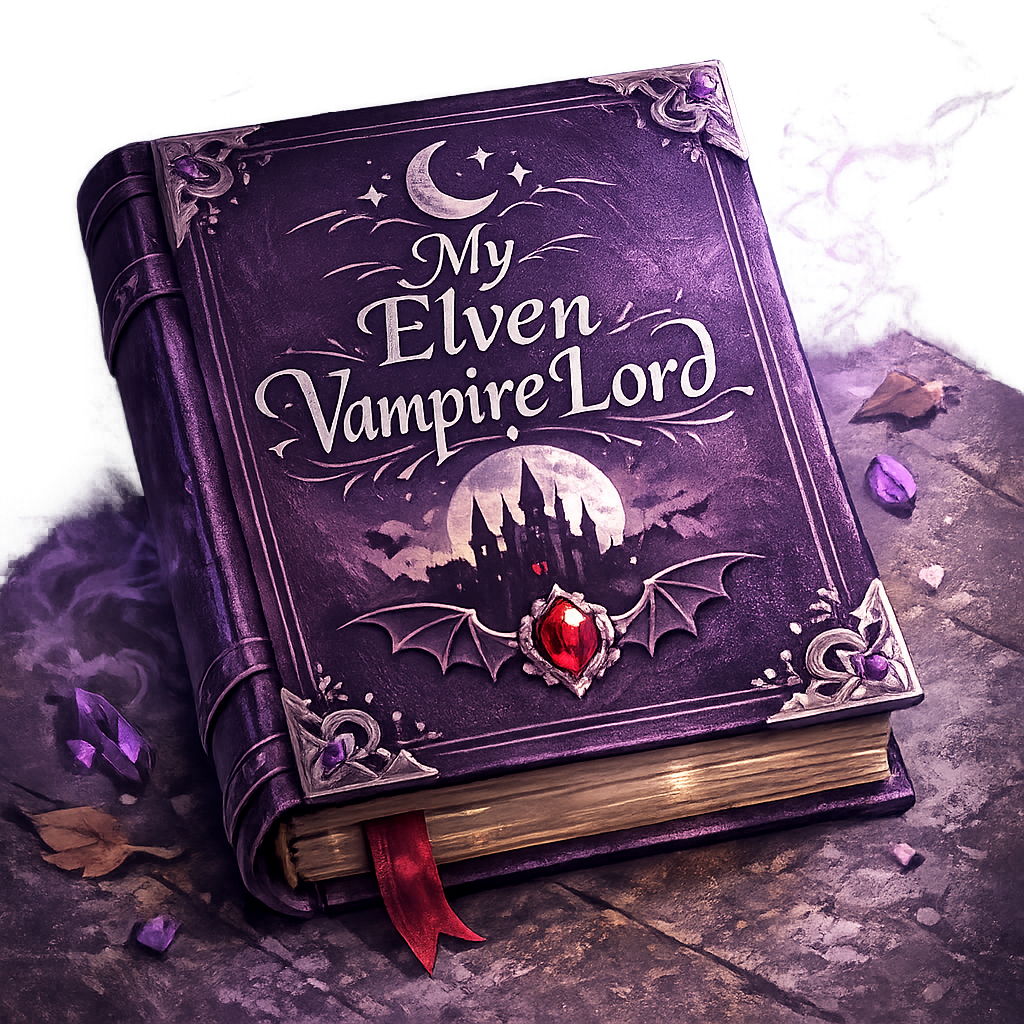
My Elven Vampire Lord
Ten excerpts from a very inadvisable entanglement · Paeviolet & Lord Vandemir
Excerpt I
The manor did not welcome the living. It endured them.
Its silver-veined doors rose three stories high, carved with lilies, moons, and the long-faced saints of dead empires, and when they parted for Paeviolet, the warmth fled her skin as if the house itself had inhaled it. Beyond the threshold, chandeliers burned with cold violet fire. Mirrors watched from gilded walls. Marble stairs swept upward like the arms of a queen too proud to embrace.
And at the top of them stood Lord Vandemir.
He was draped in black silk and moonlight, one pale hand resting on the bannister as if the entire mansion had grown around him like a jewelled coffin. His beauty was the cruel kind, the sort that made mortal girls dream of devotion and graves in the same breath. Gold flecks glimmered in his onyx eyes when the witchfire caught them, like treasure sunk in midnight.
"You smell of rain," he said softly, with all the tenderness of a blade against a throat. "And of the living world. How unfortunate."
Paeviolet tightened her fingers around the strap of her satchel. Men like him were why girls learned caution young. Men like him were why trust should be earned in drops, never poured. Yet something in his stillness made her traitorous heart wonder what it would be like to be chosen by that gaze and not destroyed by it.
Excerpt II
The dining hall glittered with such obscene magnificence that Paeviolet forgot, for one foolish second, to be afraid.
A table of polished obsidian stretched the length of the chamber, crowded with crystal goblets, silver candelabra, and arrangements of white roses so perfect they looked embalmed. No food had been laid for human hunger. Instead, there were dark wines in cut-glass decanters, sugared black fruits, and little pastries dusted in silver that tasted of roses, winter, and something perilously close to blood. Beside them sat a lacquered plate of glossy, spiral sweets glazed with amber syrup - sticky buns, her favourite.
Every portrait on the wall depicted the same family beauty: high-boned, cold-eyed, and terribly bored.
Lord Vandemir sat at the head of the table beneath a window taller than a chapel, one elbow resting against the arm of his carved chair.
"My ancestors built this house," he told her, swirling the crimson in his glass. "Stone by stone. Wing by wing. Ballroom by ballroom. While your kind still huddled in timber huts, praying disease would pass over your doors."
Paeviolet bristled. "You hate us."
A slow smile touched his mouth. The gold in his onyx eyes flashed again, wicked and fleeting.
"No," he said. "Hatred requires passion. Most mortals do not survive long enough to inspire it."
She should have hated how beautiful he looked, saying it. She should have remembered every warning ever given to foolish girls. Instead, irrationally, offensively, she found herself wanting to believe he had set the sweeter pastries nearer to her on purpose.
Excerpt III
The west wing had once been made for music, though no musician had drawn breath there in centuries.
Moonlight poured through cathedral windows onto ivory floors. The ballroom ceiling was painted with a heavenscape of stars and weeping angels, all framed in gold so heavy it seemed the house wore its wealth like armour. Every inch of the room declared the same terrible truth: whoever ruled here had never once been denied beauty.
Paeviolet stood in the centre of that brilliance, small and mortal and furious, her travel clothes suddenly feeling plain beneath that crushing splendour - close-fitting linen underlayers and a tight tank top.
"You keep all this," she whispered, "while villages starve beyond your gates."
Lord Vandemir emerged from the shadows between two marble columns, his expression unreadable.
"Yes," he said.
Just that. No excuse. No shame. Only the lazy certainty of a creature too old and too rich to imagine judgment applying to him.
Then his gaze drifted over the chandeliers, the painted ceiling, the endless mirrors, and a note of private amusement entered his voice.
"The living are always offended by extravagance," he murmured. "As if beauty were theft merely because it was not made for them."
She told herself she despised him. It would have been easier if she had. Easier than standing there half-angry, half-spellbound, already mistrusting her own instincts more than she mistrusted the monster before her.
Excerpt IV
His library was larger than most large towns.
Shelves climbed into darkness three stories above, packed with leather tomes, lacquered cases, and illuminated manuscripts older than kingdoms. Ladders of black iron slid along the walls. Velvet divans lounged beside fireplaces of green stone. The air smelled of wax, dust, old paper, and the faint iron sweetness beneath Lord Vandemir's skin.
Paeviolet trailed her fingers across the spine of a book embossed in silver thorns.
"You collect everything," she said.
He stood by the fire, half-lit in amber and shadow, wearing a house robe of midnight velvet with a collar stiff enough for a prince. A loose shirt of black silk opened at the throat beneath it, scandalously simple on him, almost like some nobleman's idea of a tank top translated into courtly decadence. "Not everything."
"No?"
His eyes lifted to hers. Gold flecks burned in the onyx depths, warm as candle sparks and just as dangerous.
"Only that which deserves to outlast the living."
Outside, thunder rolled over the cliffs. Inside, the manor seemed to lean in and listen.
Paeviolet knew better than to trust a room like this, a man like this, a silence like this. Yet the confession in his voice - if it was a confession - made her chest tighten. It was one of her worst habits, believing softness where there was only polish, searching for tenderness in things sharpened to cut.
Excerpt V
There were gardens behind the mansion, though garden was too gentle a word for them.
They sprawled in terraces of black roses, sculpted hedges, white gravel paths, and moon-pools lined with silver stone. Statues of forgotten lovers stood half-hidden among cypress trees, their mouths chipped away by time. Even nature had been disciplined into elegance here, bent to symmetry and silence under centuries of aristocratic command.
Lord Vandemir walked ahead of her, gloved hands clasped behind his back.
"The dead are simpler companions," he remarked. "They do not beg. They do not chatter. They do not pretend their brief little lives confer importance."
Paeviolet stopped beside a marble fountain where dark water spilled from the mouth of a carved angel.
"You speak of humans as if we're vermin."
He turned then, the lantern light catching the severe perfection of his face. His onyx eyes held those same impossible gold flecks, as though someone had taken a pin to the dark and let stars bleed through.
"A rat may still bite," he said. "A candle may still start a fire. I do not mistake fragility for harmlessness."
The wind stirred his hair. Somewhere beyond the hedges, wolves cried.
"And yet," he added, voice lower now, more dangerous for its softness, "you continue to interest me."
Her throat tightened. Sensible girls backed away from words like that. Sensible girls did not feel absurd, blooming warmth at the thought of being interesting to something ancient and cruel. Paeviolet, unfortunately, had never been as sensible as her trust issues pretended.
Excerpt VI
He found her alone in the corridor, still flushed from the ball, one ribbon half-loosened and her gown slipping at the shoulder so that the fitted underlayer beneath looked almost like a tank top in the candlelight.
"I don't trust you," Paeviolet said, though her voice weakened when his gold-flecked onyx eyes settled on her mouth.
Vandemir stepped closer, slow as a promise. "No," he murmured. "But you want me anyway."
She hated that he was right. Hated that her trust was always wrong - given too easily, withdrawn too late, tangled up with wanting.
He kissed her before she could answer, cool and decadent and dangerous, leaving her soft and breathless against the wall, sweet as sticky buns and twice as foolish.
When he pulled back, his thumb brushed her lip.
"You are a terrible idea," she whispered.
"And yet," he said, eyes gleaming gold in the dark, "you are still here."
Excerpt VII
The men in Vandemir's portrait gallery looked like bad decisions given cheekbones.
There were two of them beside the hearth, both leather-clad, both pale, both beautiful in the sort of way that made church bells seem suddenly useful.
One lounged in wine-dark riding leather, his black hair tied loose at the nape, his smile edged with an accent that turned Paeviolet's name into something expensive and sinful.
"Paeviolet," he purred. "How sweet. Vandemir, you did not tell us she was breakable."
The other stood in scarred black leather with silver buckles crossing his chest, broad-shouldered and wolf-still, his storm-grey eyes fixed very calmly on her throat.
"She doesn't look breakable," he said. "She looks biteable."
Paeviolet's pulse made a humiliating little attempt to escape her body
Vandemir, all silk and cruel elegance beside her, placed one hand at the small of her back
"Séverain," he said softly. "Marius. Behave."
"How dull," Séverain said.
"How unlikely," Marius added.
Excerpt VIII
The trouble with balconies, Paeviolet decided, was that they encouraged sins of observation.
Below hers, the moonlit garden opened around a black stone pool. The water smoked in the night air. Silver lilies floated on its surface. Three men stood in it as if the entire scene had been arranged by some malicious goddess of bad decisions.
Vandemir, bare-chested and pale as carved marble, leaned against the pool's edge with one arm stretched along the stone. Séverain sat half-submerged nearby, dark hair damp, his wicked mouth tilted as he murmured something in that sinful foreign accent. Marius stood beneath the fountain, water rolling over scarred shoulders and down the ridges of a body that appeared to have been designed by violence and vanity in equal measure.
Paeviolet should have gone back inside.
Immediately.
Instead, she remained very still and told herself she was gathering information.
Important information.
Tactical information.
Such as: Marius had a scar beneath his left collarbone. Séverain wore rings even in the bath. Vandemir's composure did not improve when wet; it became fatal.
Then Séverain's gaze slid, lazily, toward the balcony.
Paeviolet stopped breathing.
Marius followed it a heartbeat later.
Neither man said a word.
Vandemir merely smiled into the dark water.
Paeviolet retreated with the wounded dignity of a woman who had absolutely not been caught.
Excerpt IX
Vandemir offered her the door, and that was the cruelest part. It stood open behind Paeviolet, full of sensible choices and dull survival, while Séverain lounged by the fire in black leather, Marius watched from the window with wolf-still patience, and Vandemir stood before her in silk-dark elegance as if temptation were merely another room in his house.
“You may leave,” Vandemir said softly. “No one here will stop you.”
Séverain’s gaze lowered to her mouth. “Though some of us may mourn artistically.” Marius did not smile. “She won’t leave.” Paeviolet meant to step back. Her pride insisted on it. Her body, traitorous and warm beneath three immortal stares, stepped forward instead.
“This is indecent,” she whispered. Vandemir’s gold-flecked eyes darkened. “No. This is honest.”
S he looked once at the door, then shut it. The click was soft; the silence after it was not. Séverain’s smile bloomed. Marius turned fully from the window. Vandemir crossed to her slowly, took her hand, and brushed his mouth over her knuckles like a vow made in candlelight.
“If this ruins me,” Paeviolet said, breath unsteady, “I shall blame all of you.”
Excerpt X
Paeviolet found the forbidden shelf because Vandemir had made the mistake of telling her not to touch it.
It waited in the upper dark of his library, behind a lattice of black iron and silver thorns, where the oldest books were chained like prisoners or pets. Their spines were not labelled in ink, but in metals, bone, and little pressed stones that glimmered when she came too close. One volume pulsed faintly beneath her fingers, cold as a dead wrist. Another breathed dust into the candlelight. The third opened by itself.
Zarn was written there.
Not as the patient god of hours and endings, not as temple doctrine or priestly metaphor, but as force. River. Wound. Noose. The pages were filled with forbidden Aethermancy: diagrams of moons devouring themselves, circles of borrowed heartbeats, bodies held outside decay by threads pulled from Zarn’s own domain. Immortality, the book implied, was not a blessing. It was theft with better handwriting.